01
Application engineering
Server-rendered and single-page applications, internal tools, dashboards and customer-facing portals built on maintainable, documented codebases.
IT services · software development
SUPER ACCOUNTANTS LTD designs, builds and maintains business software: custom applications, web platforms, cloud infrastructure, automation and integrations between the systems a company already depends on.

Introduction
The registered name of the company is SUPER ACCOUNTANTS LTD. The work it does is information technology: writing software, running it reliably and connecting it to the tools around it. Nothing on this website should be read as an offer of accounting, audit or tax services.
Most requests arrive as a business problem rather than a technical specification — a process that takes too long, data that lives in too many places, a system that is expensive to change. The first job is to describe that problem precisely. The second is to build the smallest thing that genuinely solves it.
Software is treated as something that will outlive the project that created it. That means readable code, explicit configuration, automated checks and documentation written for whoever maintains the system next.
Capabilities
01
Server-rendered and single-page applications, internal tools, dashboards and customer-facing portals built on maintainable, documented codebases.
02
Environment setup, container builds, deployment pipelines and monitoring so releases are repeatable rather than improvised.
03
Relational data modelling, reporting views and interfaces that move information between systems without manual re-entry.
04
Scheduled jobs, document generation, notification flows and rule-based routing that remove repetitive administrative steps.
05
Dependency updates, defect resolution, performance work and incremental improvements to software already in production.
06
Architecture reviews, estimation support and written options analysis to help teams choose between build, buy and integrate.
Custom software development
Off-the-shelf products are the right answer more often than vendors of custom software like to admit. Custom development earns its place when a process is genuinely specific to the organisation, when it spans several systems, or when the cost of working around a product's limitations has quietly become the larger expense.
A typical build starts with the data: what entities exist, how they relate, which states they move through and who is allowed to move them. Interfaces follow from that model rather than the other way round, which keeps the system coherent as it grows.
Possible deliverables include a working application in a hosted environment, source code in the client's own repository, a database schema with migrations, automated tests and setup documentation.
Web application engineering
Web applications are the default delivery format: nothing to install, one place to update, and access controlled centrally. The engineering attention goes to the parts users feel — how fast the first screen appears, how errors are explained, how the layout behaves on a phone.
Layouts tested across phone, tablet and desktop widths, with readable type scales and sensible touch targets.
Semantic markup, meaningful headings, descriptive alternative text and respect for reduced-motion preferences.
Optimised images with declared dimensions, lazy loading below the fold and restraint with third-party scripts.
Access rules enforced on the server, not only hidden in the interface, with auditable records of sensitive actions.
Cloud and infrastructure
Infrastructure work aims at one property above all: the ability to recreate an environment from its definition. That makes staging realistic, recovery plausible and cost visible.
Business process automation
Automation starts by watching the real process: which steps repeat, which are copy-and-paste, and where mistakes actually occur. Some steps should be deleted rather than automated.
Scheduled data transfers, document generation, validation rules, notifications and approval routing — each implemented as a small, observable piece with clear inputs and outputs.
Automated steps log what they did, fail loudly rather than silently, and leave an override for the cases that need judgement.
Systems integration
Integration work is less about protocols than about meaning: two systems rarely define a customer, an order or a status in exactly the same way. Mapping those differences explicitly is most of the job, and the part that prevents quiet data corruption later.
Interfaces are built to expect failure. Requests are retried where it is safe, rejected records are captured with the reason attached, and every run leaves a trace that can be inspected afterwards.
Documented HTTP interfaces for internal and partner use, with versioning and authentication.
Scheduled or event-driven transfers with validation, transformation and error reporting.
Verified inbound endpoints that process third-party events idempotently.
Adapters that let older systems participate without being rewritten.
Security-conscious development
Accounts, tokens and database roles scoped to what they need, and nothing wider.
Credentials held in managed secret storage, never committed to source control.
Untrusted input validated on the server, with parameterised queries throughout.
Regular updates and review of known vulnerabilities in third-party packages.
Encrypted connections by default, with sensible security headers.
Collecting and retaining only the data a feature genuinely requires.
Permissions revisited as teams change, with sensitive actions logged.
No claims of certification or guaranteed security — practices, described plainly.
Delivery process
We map the current process, the people involved and the constraints — regulatory, technical and budgetary. Output is a written problem statement both sides agree on.
Scope is broken into deliverables with acceptance criteria. Anything uncertain is named as an assumption rather than hidden inside an estimate.
Work proceeds in short cycles. Each cycle produces something reviewable in a running environment, not just a status update.
Automated checks plus structured manual review against the agreed criteria, run before anything reaches a production environment.
Deployment, documentation, credentials handover and a written record of architecture decisions so the software can be maintained by others.
Optional continued maintenance: monitoring, updates, small enhancements and a defined route for reporting issues.
Engineering quality
Tests exist to make change safe. The aim is not a coverage figure but confidence in the parts that would hurt most if they broke: calculations, permissions, state transitions and integrations.
Automated checks run before code is merged, so problems surface while the change is still fresh. Manual review covers what automation reads poorly — whether a screen makes sense, whether an error message helps, whether the flow matches how people work.
Code review is a standing practice rather than a formality. Every change is read by someone other than its author, and review comments become part of the project's written record.
Illustrative scenarios
The following are illustrative examples written to explain the kind of work involved. They are not descriptions of completed client projects and do not represent any specific organisation.
Illustrative scenario
A team coordinates work across several shared spreadsheets. Versions diverge and reporting is manual. A small web application with a single database, role-based access and exportable reports would replace the fragile parts while keeping the familiar workflow.
Illustrative scenario
Order data is entered once in a sales tool and again in an operations system. A scheduled integration with validation and an error log would remove the duplicate entry and make failures visible instead of silent.
Illustrative scenario
Deployments are manual and occasional, so changes queue up and risk grows. Containerised builds, an automated test stage and a repeatable deployment pipeline would make smaller, calmer releases possible.
Illustrative scenario
A working system runs on unsupported dependencies. A staged upgrade — test coverage first, then dependency updates, then refactoring — would reduce risk without a full rewrite.
Collaboration
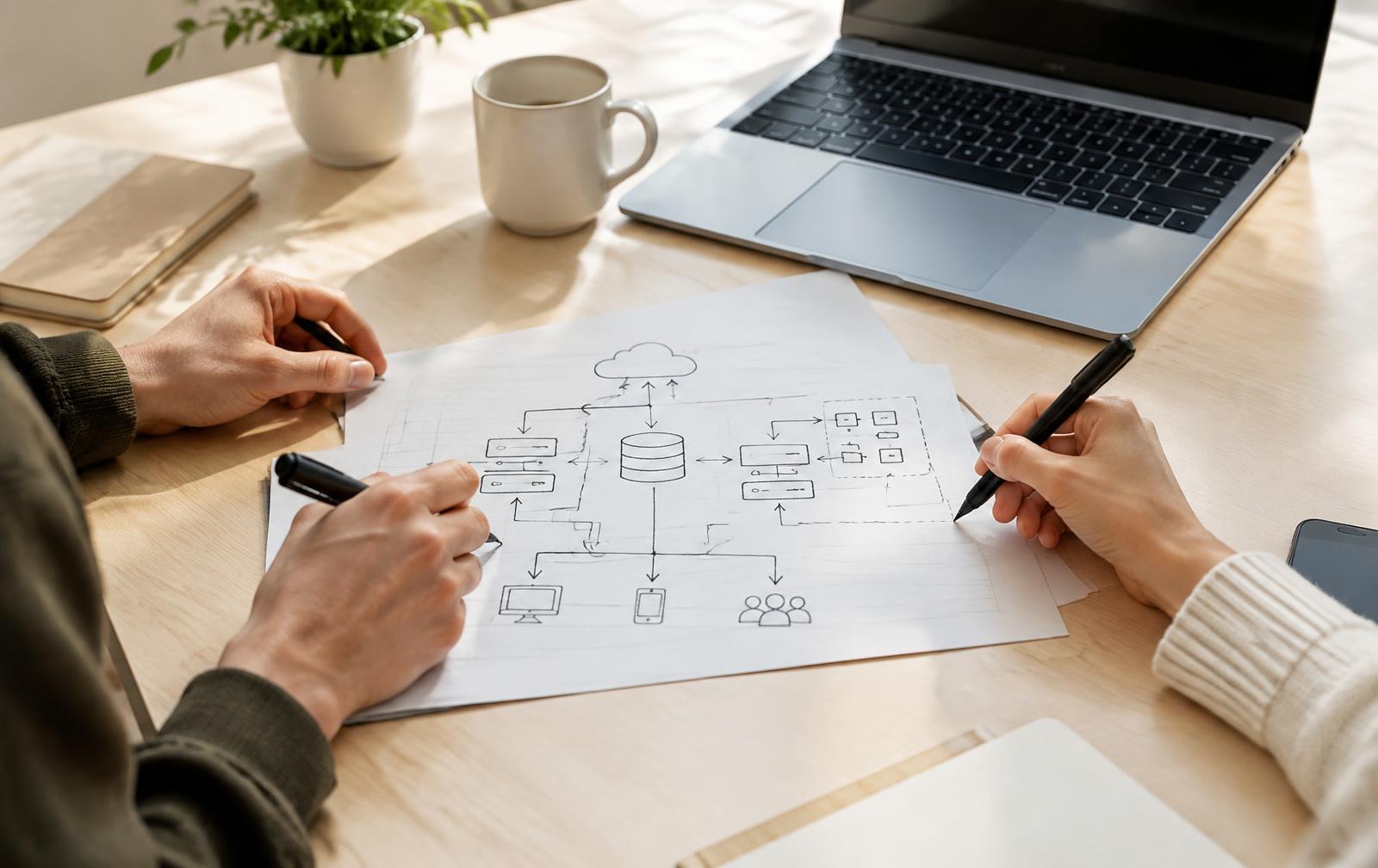
Communication is deliberately plain: written summaries, a visible task board, and a short regular check-in rather than long status meetings. Decisions are recorded where they can be found again.
Uncertainty is stated rather than smoothed over. If an estimate depends on an assumption, the assumption is written down; if it turns out to be wrong, the consequence is raised early instead of at the deadline.
Engagements are structured so the client is never dependent on a single conversation: code, credentials, documentation and decision records live with the client throughout, not only at handover.
Questions
Contact information
Company
SUPER ACCOUNTANTS LTD
raelenevang564@gmail.com
Website
superaccountantsgroup.com
Email is the contact method for enquiries about the services described on this website. No postal address, telephone number or business hours are published here.